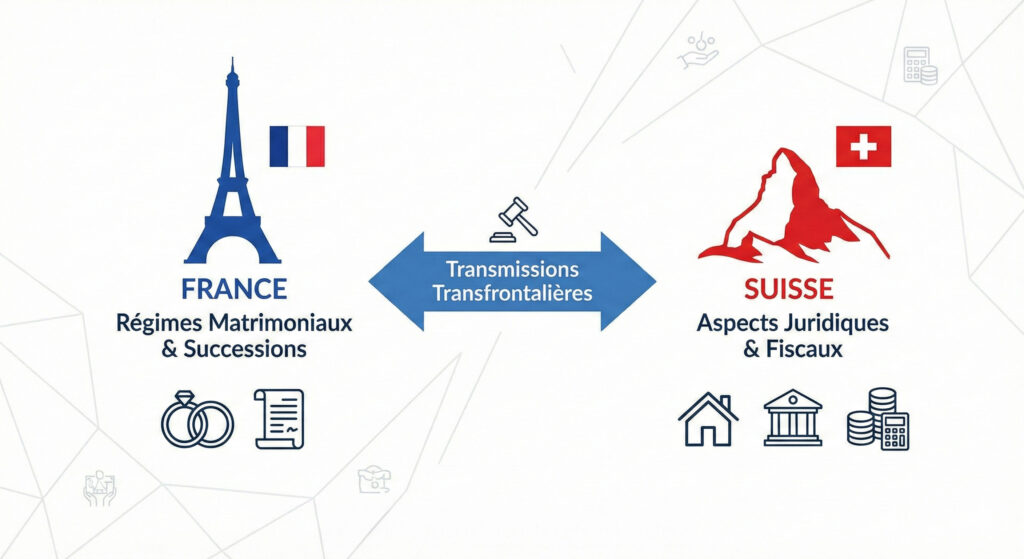
Managing a French-Swiss succession represents a major challenge for families residing in France while holding assets in Switzerland. The diversity of applicable rules regarding marital property regimes, international succession law, and inheritance taxation requires a rigorous and forward-looking approach.
This article provides a structured analysis of the main legal and tax mechanisms applicable, illustrated by practical cases, in order to identify key considerations and wealth planning optimization strategies.
A Typical French-Swiss Succession
The analysis is based on a married couple, tax resident in France, with two children, one domiciled in France and the other in Switzerland. Their estate comprises:
- real property located in France;
- real property located in Switzerland;
- a business in Switzerland in corporate form;
- banking assets in France and Switzerland.
This configuration illustrates the issues frequently encountered in international successions between France and Switzerland.
The Main Stages of Settling an International Succession
Any cross-border succession must be analyzed according to a rigorous methodology based on three pillars:
- determining what the deceased owned, which falls under the applicable marital property regime;
- identifying the heirs and their rights, according to the applicable succession law;
- applying inheritance taxation, once civil rights have been established.
It is essential not to confuse civil law and tax law, two distinct sets of rules.
The Marital Property Regime: A Major Point of Vigilance
Statutory Regimes in France and Switzerland
In the absence of a marriage contract:
- in France, the statutory regime is that of community of property limited to acquests;
- in Switzerland, it is the regime of participation in acquests.
Although similar in their philosophy, these regimes are governed by different settlement rules.
The Strategic Value of a Marriage Contract
An international marriage contract allows the choice of applicable law and marital property regime. It is recognized by both France and Switzerland and provides lasting legal certainty.
Absence of Contract and Conflicts of Laws
Without a contract, the applicable law depends notably on the date of marriage and changes of residence. French and Swiss rules may lead to divergent analyses, particularly regarding automatic mutability and retroactivity.
These situations make the settlement of the marital property regime particularly complex.
The Law Applicable to the Succession
The determination of succession law is more harmonized than that of the marital property regime:
- in Switzerland, the law of the deceased’s last domicile applies;
- in France, the law of the last habitual residence is applied.
For a French resident, French succession law applies in principle to all assets, whether located in France or Switzerland, in accordance with the principle of unity of succession.
The Choice of Succession Law
A Swiss national or dual French-Swiss national may choose the application of Swiss succession law. This option is recognized by both French and Swiss authorities.
However, this choice only has effect on the civil law level and does not result in any automatic exemption regarding French inheritance taxation.
Comparison of French and Swiss Succession Rights
Rights of the Surviving Spouse
- in Switzerland, the spouse receives half of the succession in full ownership;
- in France, the spouse has an option between a share in full ownership or usufruct of the succession.
The Reserved Portion
- in Switzerland, the spouse is a reserved heir;
- in France, the reserved portion depends on the number of children.
The choice of succession law therefore directly influences the balance between spouse and descendants.
Taxation of Successions Between France and Switzerland
Since the abolition of the tax treaty on inheritance matters, each State applies its own rules.
Opposing Tax Logic
- in Switzerland, taxation depends on the cantons and often remains favorable in direct line;
- in France, the progressive scale can reach very high levels.
Managing Double Taxation
When the deceased is tax domiciled in France, the entire succession is taxable in France, with a tax credit mechanism for certain taxes paid in Switzerland.
Wealth Planning Optimization Strategies
Several tools may be considered to reduce tax pressure:
- gifts in full ownership or with dismemberment;
- life insurance, benefiting from a specific tax regime;
- the transfer of Swiss real property, requiring local legal coordination.
The Plan to Relocate to Switzerland and Its Limitations
A change of residence is not sufficient to neutralize French taxation. Particular consideration must be given to:
- the Exit Tax mechanism;
- the criteria for determining French tax domicile;
- the rules of succession territoriality.
Conclusion
French-Swiss successions require rigorous planning and personalized analysis. The marital property regime, succession law, and taxation must be considered jointly.
As each situation is unique, guidance from legal and wealth management professionals is essential to secure the transfer and protect the heirs.