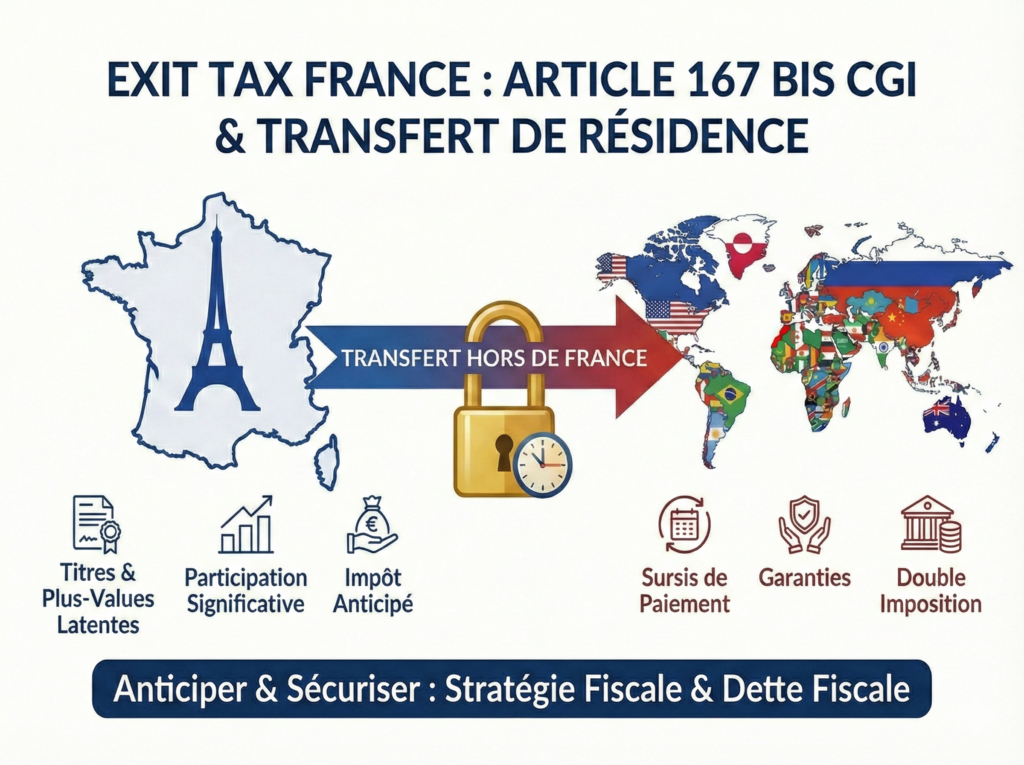
Transferring your tax residence outside France is a major wealth-planning decision. When a taxpayer holds significant shareholdings in companies, this departure may trigger the application of the Exit Tax, provided for under Article 167 bis of the French General Tax Code. This mechanism is intended to tax unrealised capital gains on securities, i.e. gains not yet realised, which requires rigorous advance planning.
The principle of the Exit Tax
The purpose of the Exit Tax is to tax unrealised capital gains on securities held by French taxpayers at the time they transfer their tax residence outside France.
It applies in particular when the taxpayer meets the following conditions:
- they have been a French tax resident for at least a significant period during the years preceding the departure;
- and they hold either a significant shareholding in a company, or securities whose aggregate value exceeds a certain threshold, assessed by aggregating all securities held, listed or unlisted, including those held in securities accounts.
The shareholding and value criteria are alternative: either one is sufficient to trigger the regime.
The preparation of the file, exchanges with the tax authorities and the arrangement of guarantees require technical preparation and a documented strategy.
The effects of moving abroad
The departure makes the capital gains on the relevant securities taxable: they must be reported and are taxed under the applicable regime, including the 12.8% flat tax and social contributions.
In other words, a tax liability arises as soon as you leave, even if no disposal is carried out immediately and no proceeds are received.
Deferral of payment
To avoid immediate payment, the regime provides for a deferral of payment, allowing the tax to be deferred, subject to strict conditions and reporting obligations.
Automatic deferral of payment
In certain cases of moving abroad, the taxpayer benefits from an automatic deferral: no tax is paid immediately, but reporting obligations must be complied with.
Deferral on request with guarantees
For certain destinations, the deferral must be requested from the tax authorities before departure and guarantees must be provided. Preparing the file, communicating with the authorities, and organizing the necessary guarantees require technical preparation and a documented strategy. In particular, there is no automatic deferral of payment in the event of a move to Switzerland or Andorra, Dubai or Singapore.
The deferral of payment ends in particular in the event of a disposal, a capital reduction, a cancellation of shares or similar transactions.
Extinguishment of the tax liability
If the taxpayer retains their securities for a certain period from the date of departure, the tax on unrealised capital gains may be cancelled. This period varies depending on the aggregate value of the securities held at the time of departure.
Please note: the Exit Tax on capital gains subject to tax deferral is, however, never cancelled.
Exit Tax and the risk of double taxation
The Exit Tax may give rise to double taxation, in particular where transactions carried out after departure are also taxed in the state of residence, under a different legal rationale.
A practical case illustrates this: a taxpayer who became a tax resident in Geneva, the sole shareholder of a company governed by Swiss law, reported their Exit Tax in France and obtained a deferral of payment with guarantees. They then consider dissolving the company.
However, a dissolution may generate a liquidation gain that could cause the deferral to lapse, making the Exit Tax immediately payable in France, while the state of residence may tax the gain under its own rules. Double taxation may then not be neutralised if the taxes involved do not have the same legal nature.
Best practices and points to watch
- Anticipate the formalities when moving to a country that does not allow you to benefit from an automatic deferral of payment
- Verify and secure the strategy for holding the securities during the post-departure holding period;
- anticipate post-departure transactions likely to bring the deferral of payment to an end;
- remain cautious regarding distributions and the management of a low-activity structure, in order to avoid any risk of recharacterisation or abuse of law;
- pay particular attention to deferred capital gains, the taxation of which does not disappear over time.
Conclusion
The Exit Tax is a demanding regime, often underestimated when transferring tax residence outside France. Poor planning can lead to significant immediate taxation and, in some cases, double taxation that is difficult to remedy.
Before any departure, a tailored analysis is essential, taking into account the holding structure, the value of the securities, the transactions envisaged after departure and the tax rules of the host state.