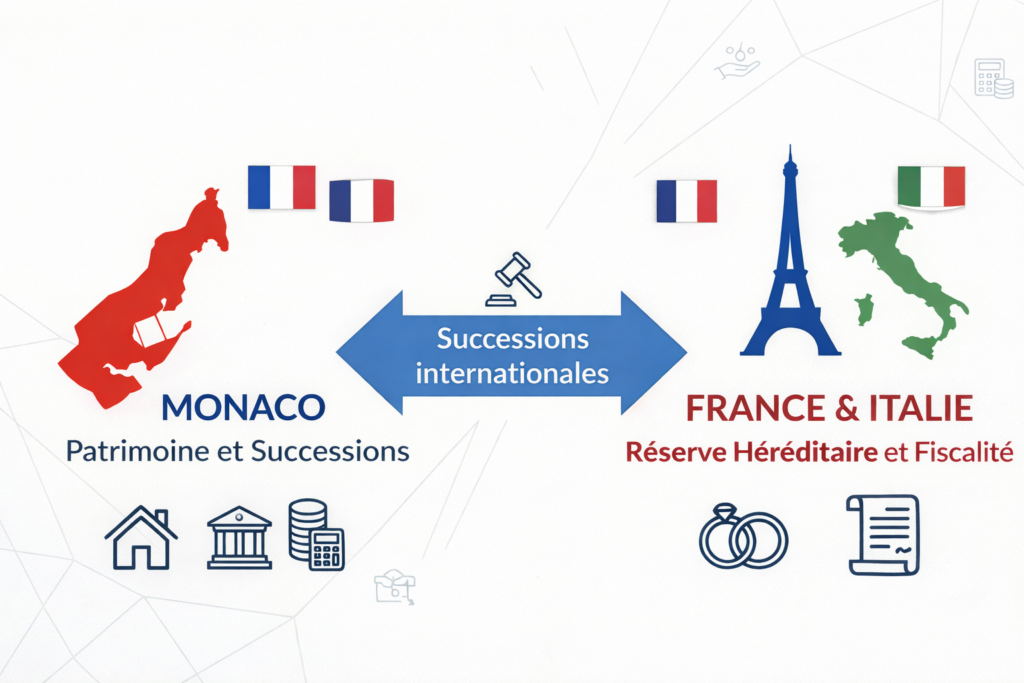
Inheritance in Monaco is an essential subject for families and entrepreneurs with international assets. The Principality attracts residents with strong family and economic ties to France and Italy, as well as financial hubs like Switzerland. In this context, transferring assets involving multiple states requires a rigorous analysis of the matrimonial regime, the applicable inheritance law, forced heirship mechanisms, and inheritance tax rules.
Based on a practical case presented in a webinar, this article offers a structured, clear, and educational overview of the legal reflexes to adopt to secure a Monegasque succession and limit the risks of litigation and double taxation.
Practical Case: Assets Distributed Between Monaco, France, Italy, and Switzerland
The analyzed scenario concerns a couple residing in Monaco, regardless of their nationality, with children established in several countries. The estate combines real estate held directly and via civil structures, assets located in Monaco and abroad, as well as bank accounts in several jurisdictions.
This type of situation is typical for international families: points of friction mainly appear regarding private international law, forced heirship based on nationality, and tax jurisdiction based on the location of assets and liability criteria.
Matrimonial Regime in Monaco: Marriage Contract or International Rules
The Principle: Recognition of the Marriage Contract
Monaco recognizes marriage contracts established before a competent authority in another state, provided they are valid regarding the applicable forms and rules. For international couples, this tool remains an essential lever for asset security: it reduces uncertainties regarding the classification of assets and prepares for liquidation prior to any succession.
In the Absence of a Contract: Determination by the First Matrimonial Domicile
In the absence of a contract, the applicable matrimonial regime is determined according to international logic: the regime is linked to the first matrimonial domicile, corresponding to the place of the first years of common life after marriage. This approach aims to identify the law most closely linked to the couple’s situation at the time of the union.
The Monegasque Statutory Regime: Separation of Property
In Monaco, the statutory regime is that of separation of property when the conditions for attachment to Monaco are met. This characteristic is decisive in practice: it impacts the prior liquidation of the matrimonial regime and the composition of the estate by strictly distinguishing the spouses’ assets.
Law Applicable to the Succession: Last Domicile and Unity of Succession
Guiding Principle: The Law of the Deceased’s Last Domicile
The determination of the applicable inheritance law is centered on the principle of attachment to the last domicile of the deceased. In the case of a Monegasque resident on the day of death, the succession is, in principle, governed by Monegasque law for the entire estate, regardless of where the assets are located.
This logic promotes the unity of succession and the consistency of the inheritance settlement, which is particularly sought after when the estate includes assets in France, Italy, Monaco, and financial jurisdictions.
Point of Attention: Forced Heirship and the Deceased’s Nationality
A Monegasque specificity must be integrated into any strategy: the mechanism relating to forced heirship may refer back to the national law of the deceased. This means that even if Monegasque law governs the succession, the determination of the minimum protected share for certain heirs may depend on nationality.
Practical Consequence: A deceased person of foreign nationality domiciled in Monaco may see a different protective logic for forced heirship than that of Monegasque law. The contrast is particularly marked when the national law recognizes forced heirship rights for the spouse, whereas the surviving spouse is not a forced heir under Monegasque law.
Uncertainties and Operational Prudence
This referral to national law regarding forced heirship can generate interpretation difficulties depending on the countries involved and family configurations. In practice, this requires a thorough case-by-case analysis, particularly for non-European nationalities or legal systems without forced heirship.
Can One Choose Another Inheritance Law in Monaco?
Professio Juris: Choosing the Law of One’s Nationality
Monegasque law allows individuals to opt for the application of the law of their nationality to govern their succession. This choice is typically expressed through a will or appropriate deed. The objective is to align the succession with national law when it better meets the goals of asset transfer, spouse protection, or family organization.
This option is also consistent with European mechanisms applicable in France and Italy, which also allow for a choice of national law. However, the choice must be designed methodically to avoid conflicts of laws, particularly regarding Monegasque rules on forced heirship.
The Benefit of Choice of Law: Adapting the Succession to Asset Goals
The choice between the law of residence and national law can produce major effects on:
- Forced heirship and protected heirs
- The rights of the surviving spouse, particularly in the presence of blended families
- Transfer tools, such as usufruct, full ownership, and certain inheritance options
- Legal certainty and the prevention of litigation
An essential principle emerges: the clause relating to forced heirship only has an impact in practice if the deceased has made arrangements likely to affect the forced share, for example via a will or donations. Without anticipation, legal devolution applies, and heirs receive their rights within the framework set by the competent law.
Do Not Confuse Civil Law and Inheritance Taxation
A fundamental educational point must be reiterated: civil law and tax law belong to distinct bodies of law. Civil law determines who inherits, in what proportions, and under what terms. Tax law determines where and how the transfer is taxed, based on the location of assets and the liability criteria of the states involved.
Consequently, the fact that Monegasque law or national law governs the succession does not automatically imply the absence or presence of taxation in another country. A succession governed civilly by Monaco can produce taxation in France or Italy, particularly in the presence of real estate or specific tax residence criteria.
Rights of the Surviving Spouse: Comparison of Monaco, France, and Italy
Monaco: Spouse Not a Forced Heir and Legal Entitlement
Monaco is distinguished by a notable peculiarity: the surviving spouse is not a forced heir. In the absence of a will, they nevertheless receive a legal share comparable to that of a child, the importance of which varies according to the family configuration. This logic must be anticipated, as it may deviate from the expectations of families accustomed to other European systems.
Italy: Full Ownership Rights and Spouse’s Forced Share
In Italian law, the spouse has legal rights to full ownership that depend on the presence and number of children. Most importantly, the spouse is a forced heir, which strongly influences transfer strategies when the deceased is of Italian nationality or when forced heirship refers back to national law.
France: Options and Usufruct Mechanisms Under Conditions
In French law, the spouse may have legal rights to full ownership and, in certain situations, benefit from a usufruct logic, particularly in the presence of common children. Conversely, in blended families, the spouse’s rights are more restricted, which sometimes makes French law more suitable for spouse protection goals when usufruct over the entire estate is sought.
Forced Heirship and Disposable Portion: Monegasque Logic and Comparison
In Monaco, the forced heirship of children is assessed based on the number of children and leads to the delimitation of the disposable portion, i.e., the share that can be freely disposed of. France has a similar architecture regarding children’s forced heirship, while offering specific options for the benefit of the spouse, notably through usufruct arrangements depending on the family situation.
The choice of law can therefore become decisive when the goal is to favor a spouse within a blended family: certain options available under French law do not produce the same effects under Monegasque law.
Inheritance Taxation in Monaco: Taxation Limited to Assets Located in the Principality
Principle: Monaco Taxes Assets Located in Monaco
Regarding inheritance tax in Monaco, the approach is territorial: the Principality taxes transfers involving assets located in Monaco, regardless of the domicile of the deceased or the heirs. Assets located abroad are not, in principle, subject to this Monegasque taxation.
This rule is essential in situations involving foreign bank accounts: assets located outside Monaco do not enter the Monegasque tax base, while assets and accounts located in Monaco may be taxed according to the family relationship.
Practical Consequences for International Assets
For a Monegasque resident, a local bank account or property located in the Principality may incur taxation according to the degree of kinship, whereas a bank account located in Switzerland will not be taxed in Monaco. This dissociation requires a precise reading of asset location and classification.
Comparative Taxation: France and Italy
Italy: Less Extensive Rules and Taxation Centered on Location and the Deceased’s Domicile
The Italian regime is presented as less extensive than the French regime. When the deceased is not domiciled in Italy, Italy mainly taxes assets located in Italy. Conversely, if the deceased is domiciled in Italy, taxation may apply to the entire estate, including assets located abroad, with a mechanism for taking into account tax paid abroad depending on the situation.
An important specificity is highlighted: the heir’s situation has a much more limited impact in Italy than in certain French scenarios, which reduces the ripple effect linked to the beneficiaries’ domicile.
France: Liability Criteria and Possible Global Scope
In France, when the applicable treaty does not apply, internal tax domicile criteria can lead to broad taxation. France specifically examines the household, main residence, main professional activity, and center of economic interests. This last criterion may concern Monegasque residents with significant rental real estate assets in France.
Depending on the configuration, France may tax extensively, either due to the deceased’s situation or due to the tax domicile of certain heirs, which requires a fine analysis of the risk of liability and assets considered to be located in France, including via holdings and certain securities.
France-Monaco Tax Treaty: A Specific and Strategic Framework
An Atypical and Non-Exhaustive Treaty
The tax treaty between France and Monaco regarding inheritance is described as particularly unique. Not all gratuitous transfers are covered: donations are expressly excluded, and not all successions are eligible. When the treaty does not apply, internal French rules regain full effect.
Major Effects When the Treaty Applies
When the treaty is applicable, it produces two structural consequences:
- It prevents France from taxing based on the heir’s tax domicile in the covered situations
- It limits taxable assets in France to certain categories, mainly physical property located in France, according to the treaty’s logic
In this context, many assets that could be taxed under French domestic law may be excluded from French taxation when the treaty can be invoked, making it a central element of asset structuring.
Nationality and Non-Discrimination Clause: A Case-by-Case Analysis
The treaty utilizes criteria related to the nationality of the deceased and may, in certain hypotheses, extend to nationals of other countries via non-discrimination clauses present in other treaties concluded with France. This mechanism requires true treaty mapping: verifying the existence of a relevant treaty, the presence of a non-discrimination clause, and its scope of application, even when the person concerned is not a resident of the signatory states.
This approach, reinforced by jurisprudential references mentioned in the webinar, justifies increased caution and specialized support, particularly for non-French and non-Monegasque nationalities.
Asset Structuring: Direct Ownership, Civil Companies, and Asset Location
The methods of holding real estate and financial assets play a decisive role in tax exposure, particularly regarding the France-Monaco treaty and internal French rules. Depending on the situation, holding assets directly or via a structure can change the classification of the assets and the state competent to tax.
In practice, it is essential to anticipate:
- The legal and physical location of assets, particularly for real estate and certain physical property
- The holding structure, directly or via civil entities and companies
- The tax profile of the deceased and the heirs, and the risks of reclassification in France
- Compatibility between choice of law, forced heirship, and family goals in the presence of blended families
Conclusion: An Effective Monegasque Strategy Relies on an Integrated Approach
An inheritance in Monaco is prepared at the intersection of private international law, civil inheritance law, and cross-border taxation. The principle of unity of succession around the Monegasque domicile offers a structural basis, but forced heirship linked to nationality, differences in surviving spouse rights, and French and Italian tax rules require tailor-made planning.
To secure the transfer, limit the risks of family litigation, and manage taxation, a professional approach must combine asset auditing, choice of law, wills, and multi-jurisdictional tax analysis, with particular attention paid to the France-Monaco treaty and holding structures.