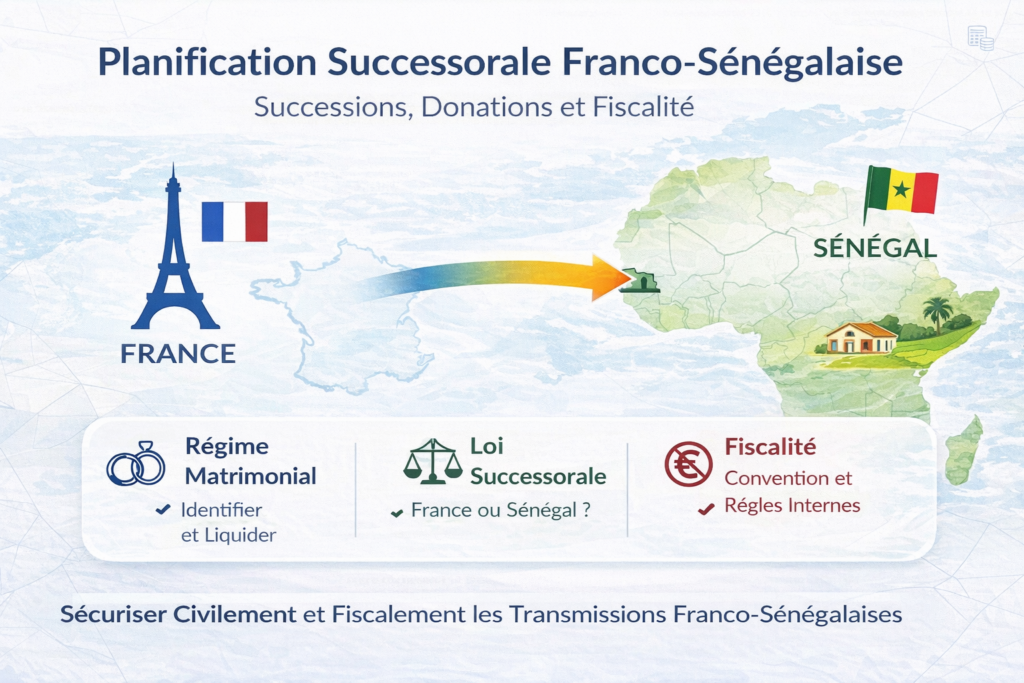
This Avacor webinar is devoted to Franco-Senegalese estate planning, a topic that is still poorly documented but essential for families with wealth interests between France and Senegal. The analysis is conducted through a practical case study and is intended for individuals resident and domiciled in Senegal, with assets and heirs spread across several jurisdictions.
The approach adopted is based on a classic but fundamental methodology for international wealth transfers: identify the matrimonial property regime, determine the applicable succession law, then analyse the tax treatment. Any error in any of these steps may lead to significant wealth and tax consequences.
Senegalese legal framework: background elements
Senegal adopted a Family Code that came into force in the early 1970s. Until that date, French civil law, in the form it took prior to certain major reforms, remained applicable. Subsequent developments in French law, particularly in relation to matrimonial property regimes, were not incorporated into Senegalese law.
The webinar deliberately limits itself to general law and does not address the succession rules of Muslim law, which follow a distinct logic.
Method for winding up an international estate
The winding up of an estate involving a married couple must be carried out in three successive and inseparable stages.
-
Determine what the deceased owned, by identifying and winding up the matrimonial property regime.
-
Determine who inherits what, through the applicable succession law.
-
Analyse the tax treatment, by identifying the competent State and the applicable tax rules.
Taxation therefore comes into play only at the final stage, once the estate and the heirs’ rights have been clearly established.
Matrimonial property regimes under Senegalese law
Distinction based on the date of marriage
The applicable matrimonial property regime depends on the date of marriage. Spouses married before the entry into force of the Family Code may fall under separation of property or a community-type regime akin to participation in acquisitions, depending on the circumstances of the marriage and the possible existence of a prior agreement.
For marriages celebrated thereafter, the default regime is separation of property, with the possibility of opting at the time of marriage for a specific community regime provided for by Senegalese law.
Structuring principles of Senegalese law
Senegalese law is characterised by several strong principles:
-
No marriage contract in the French sense of the term.
-
Limited choice to the regimes provided for by law.
-
Immutability of the matrimonial property regime, the choice made at the time of marriage being irrevocable.
Specific features of the Senegalese community regime
The Senegalese community regime of participation in acquisitions has a major particularity: only real estate owned before the marriage or received gratuitously constitutes separate property. Other assets, including certain movable assets received gratuitously, are included in the pool of acquisitions, which may be surprising in light of assumptions derived from French law.
Matrimonial property regime and international situations
Where there is a foreign element, the law applicable to the matrimonial property regime depends on the existence of a marriage contract and the rules of international connecting factors.
Where a marriage contract was signed abroad, in particular in France, the provisions of that contract and the chosen law continue to apply, even after moving to Senegal.
In the absence of a contract, the proprietary effects of the marriage are in principle governed by the spouses’ common national law or, failing that, by the law of the common domicile established after the marriage.
Applicable succession law: France or Senegal
Determining the succession law is central, as it sets the surviving spouse’s rights, the distribution among children, and the existence of a forced heirship reserve.
Senegalese connecting principle based on nationality
Under Senegalese law, the estate is governed by the deceased’s national law. A Senegalese or dual-national deceased is subject to Senegalese succession law for all of their assets, whether located in Senegal or abroad.
French approach and international coordination
French law applies a different mechanism based on the last habitual residence, subject to acceptance of jurisdiction by the relevant foreign law. In practice, for a deceased of French nationality residing in Senegal, French succession law is intended to govern the entire estate.
It is essential to distinguish civil law from tax law. The applicable succession law does not, by itself, determine the tax regime.
Surviving spouse’s rights and forced heirship reserve: major differences
Surviving spouse’s rights
Under Senegalese law, the surviving spouse is entitled to receive a share equivalent to that of a child, subject to a capped limit. This approach differs profoundly from French law, under which the spouse benefits from a right of election between full ownership and usufruct in certain family configurations.
Forced heirship reserve
The forced heirship reserve exists in both systems, but under different arrangements. Under Senegalese law, it is a global reserve benefiting all statutory heirs, including the spouse. Under French law, only children are reserved heirs where there are descendants, the spouse being a reserved heir only in the absence of children.
These divergences justify an in-depth reflection on the applicable succession law and on planning tools.
Taxation of Franco-Senegalese inheritances and gifts
Existence of a bilateral tax treaty
France and Senegal are bound by a tax treaty covering inheritances and, for certain assets, gifts. A careful reading is essential, as not all transfers are covered uniformly.
Allocation of taxing rights
The treaty allocates exclusive taxation of certain assets to the State where they are located, in particular real estate, businesses and tangible movable property. Other assets are, in principle, taxable in the State of the deceased’s last domicile.
This treaty logic neutralises certain criteria of French domestic law, in particular those based on the heirs’ domicile.
Comparative taxation
Senegalese taxation of gratuitous transfers appears particularly favourable in the direct line, with moderate rates applicable to the spouse and descendants. Conversely, French taxation is based on a progressive scale that may reach high levels.
Special case of life insurance
Life insurance policies are subject to specific rules that are not covered by the succession treaty. Thus, a beneficiary domiciled in France may be subject to French taxation, even where equivalent assets held directly would have escaped such taxation under the treaty.
Gifts: a more limited treaty scope
In relation to gifts, the treaty covers only certain assets, mainly real estate and business goodwill. For other assets, it is necessary to revert to domestic law, which may lead to taxation in France where the inheritance would have benefited from treaty protection.
This situation sometimes leads to a counter-intuitive conclusion: not planning ahead may, in some cases, be more tax-efficient than making a gift.
Practical takeaways and points of attention
-
Identify and wind up the matrimonial property regime before any succession analysis.
-
Determine the applicable succession law based on nationality and the international context.
-
Do not confuse civil law and tax law, as the rules are autonomous.
-
Analyse gifts carefully, as certain transfers may be taxed more heavily than inheritances.
-
Plan ahead for the transfer of French real estate, which remains taxable in France.
Conclusion: tailored planning
Franco-Senegalese estate planning perfectly illustrates the complexity of international transfers. It requires a holistic analysis, integrating the matrimonial property regime, the succession law, and treaty and domestic taxation.
No standardised solution exists. Each situation must be assessed in light of all family, wealth and legal parameters. Support from professionals who master both systems remains a decisive factor for legal certainty and peace of mind in wealth matters.