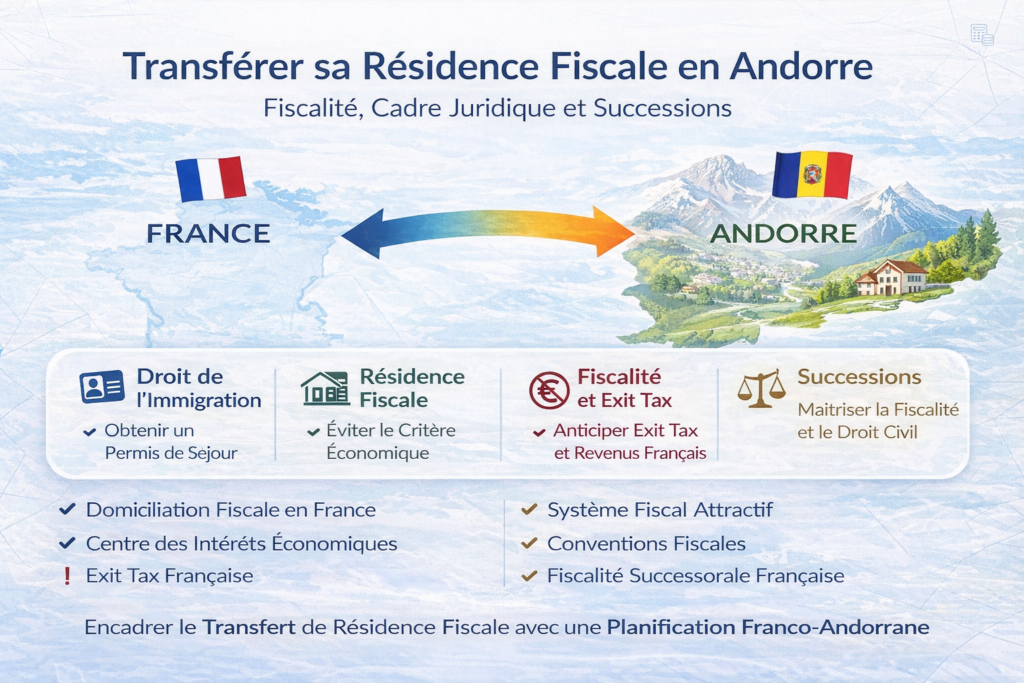
Andorra is increasingly attracting French taxpayers seeking a secure living environment, transparent taxation and a dynamic economic climate. However, a relocation project can never be reduced to a simple comparison of tax rates. It requires a comprehensive analysis integrating immigration law, tax residence, tax treaties, exit tax and the consequences regarding gifts and succession.
This webinar offers a practical analysis of the transfer of tax residence from France to Andorra based on a case study: a couple of French nationals, established or in the process of establishing themselves in the principality, with real estate and banking assets distributed between France and Andorra, and children, one of whom remains in France.
Andorra in Brief: A Structured Micro-State in Transformation
Andorra is a micro-state located between France and Spain, recognized for its unique institutional model of co-principality. The country has undergone profound transformation in recent years: economic diversification, international normalization, enhanced attractiveness for entrepreneurs, senior executives, investors, artists and athletes.
Quality of life is often highlighted: low crime, budgetary stability, modern infrastructure, structured healthcare system and diverse educational offerings including French-language education.
Immigration Law: Andorra Is Not Schengen
A key point is often underestimated: Andorra belongs neither to the European Union nor to the Schengen Area. A French national must therefore obtain a residence permit to establish themselves there.
Active Residence Permits: Working and Conducting Business in Andorra
So-called active permits allow the conduct of economic activity on Andorran territory. They notably concern:
-
The employee permit, linked to employment within a local entity and to working conditions compliant with immigration requirements.
-
The self-employed permit, generally based on significant participation in an Andorran company, with residence, housing, social security contributions and financial guarantee obligations.
-
The liberal profession permit, subject to additional conditions, notably recognition of qualifications and, depending on the profession, a required level of Catalan language proficiency.
Passive Residence Permit: Residing Without Conducting Local Activity
The permit without gainful activity is intended for persons wishing to reside in Andorra without conducting economic activity there. It generally requires:
-
Proof of sufficient resources and private health insurance.
-
A minimum presence requirement on the territory.
-
An investment in Andorran assets and the deposit of financial guarantees according to applicable conditions.
This immigration stage must be addressed in advance, as tax residence and wealth planning require a legally secured establishment.
Tax Residence in Andorra: Criteria and Evidence
Under Andorran law, tax residence is based on a combination of factors. The approach typically emphasizes effective presence on the territory and economic ties.
In practice, securing residence requires consistent documentation: housing, presence, activity, center of interests, family organization, banking flows and elements of daily life.
Tax Residence in France: Domestic Criteria Remain Decisive
On the French side, tax domicile is based on alternative criteria. Meeting just one is sufficient to be considered tax domiciled in France. The main criteria relate to:
-
Home: place of residence of the spouse and minor children.
-
Principal place of stay: the state in which presence is most significant over the year.
-
Principal professional activity conducted in France.
-
Center of economic interests: principal source of income, notably including rental income, dividends, capital gains and pensions.
A transfer of residence to Andorra must therefore be analyzed rigorously to avoid residual qualification in France, particularly through the center of economic interests criterion.
Tax Treaties: A Scope Not to Be Confused
A tax treaty may exist for income tax, but this does not mean it automatically covers gifts and succession. This distinction is fundamental.
In practice, it is common to find that taxpayers consider themselves protected by a treaty, even though gratuitous transfer duties fall under a different set of rules. It is therefore essential to distinguish income tax law and wealth taxation.
Andorran Taxation: An Attractive but Regulated Framework
Andorra is characterized by taxation often described as moderate, particularly regarding income tax and corporate tax. The system is generally presented as transparent, with limited tax pressure compared to France.
Indirect taxation, including a consumption tax, is also described as relatively low.
French Exit Tax: A Major Point of Vigilance
The transfer of tax residence outside France may trigger the exit tax, a mechanism designed to tax certain latent or deferred capital gains on securities. This subject is technical and must be anticipated before departure, particularly regarding:
-
The qualification of the securities concerned.
-
Reporting obligations.
-
Conditions and guarantees relating to payment deferral.
A preliminary audit is generally essential when the estate includes significant holdings or assets likely to generate substantial capital gains.
Tax Treatment of French-Source Income: Category-by-Category Approach
A transfer of residence to Andorra requires organizing the taxation of income retaining a French source, notably:
-
Pensions: depending on their nature, they may be subject to distinct rules.
-
Dividends: France typically applies withholding tax on certain income paid to non-residents.
-
Rental income from properties located in France: it remains in principle taxable in France, with specific procedures for non-residents.
-
Capital gains: their treatment depends on the nature of the asset, the level of participation and any interaction with the exit tax.
The strategy consists of coordinating French and Andorran rules, securing tax residence and properly documenting the tax borne.
Real Estate Wealth Tax: Continued French Exposure
A non-resident may remain liable for real estate wealth tax in France on real property located in France, held directly or indirectly, subject to meeting applicable thresholds. The analysis must also consider interposed structures and potential reclassification of certain assets.
Succession and Civil Law: The Applicable Law Is Not Taxation
In succession matters, the first question is that of applicable law, which determines who inherits what, the position of the spouse, forced heirship and the validity of lifetime arrangements.
In an international context, private international law mechanisms may lead to the application of French law for a French national, even when habitual residence is in Andorra. This can secure the consistency of instruments already in place, such as wills or gifts between spouses.
Note: the civil law applicable to succession does not, by itself, determine succession taxation. Civil law and tax law must be addressed separately.
French Succession Taxation: Taxation Criteria in the Absence of a Treaty
When succession taxation is not covered by a bilateral treaty, France applies its domestic rules without limitation. Common scenarios leading to taxation in France notably include:
-
Tax domicile of the deceased in France under domestic criteria: potential taxation on a broad base, including assets located outside France.
-
Heir domiciled in France according to applicable criteria, in certain configurations: taxation of the share received, including on assets located outside France.
-
Assets located in France: taxation may remain even when the deceased and heirs are outside France.
In this context, wealth planning aims to reduce uncertainty and control the taxable base in France, consistent with the family situation.
Optimization and Best Practices: Securing the Project and Reducing Risks
A transfer of tax residence to Andorra requires an integrated approach, particularly when the family and assets remain partially in France. The generally priority areas of work are as follows:
-
Tax residence audit: analysis of French and Andorran criteria, mapping of reclassification risks.
-
Structuring of income and assets: organization of flows, asset arbitrage, documentation of ties.
-
Exit tax management: analysis of securities, anticipation of obligations, guarantee strategy if necessary.
-
Succession planning: consistency between matrimonial regime, testamentary dispositions, forced heirship and family objectives.
-
Transmission: consideration of gifts, life insurance and other instruments, taking into account French rules applicable to non-residents.
Conclusion: An International Solution Requires an International Method
Andorra can constitute a particularly attractive destination from a tax and wealth perspective, provided the project is approached methodically. The points of vigilance are rarely Andorran: they most often arise from the country of departure, French residence rules, exit tax and succession taxation.
The key lies in coherent, documented cross-border planning compatible with both systems. A relevant solution is neither exclusively French nor exclusively Andorran: it must be truly Franco-Andorran.